
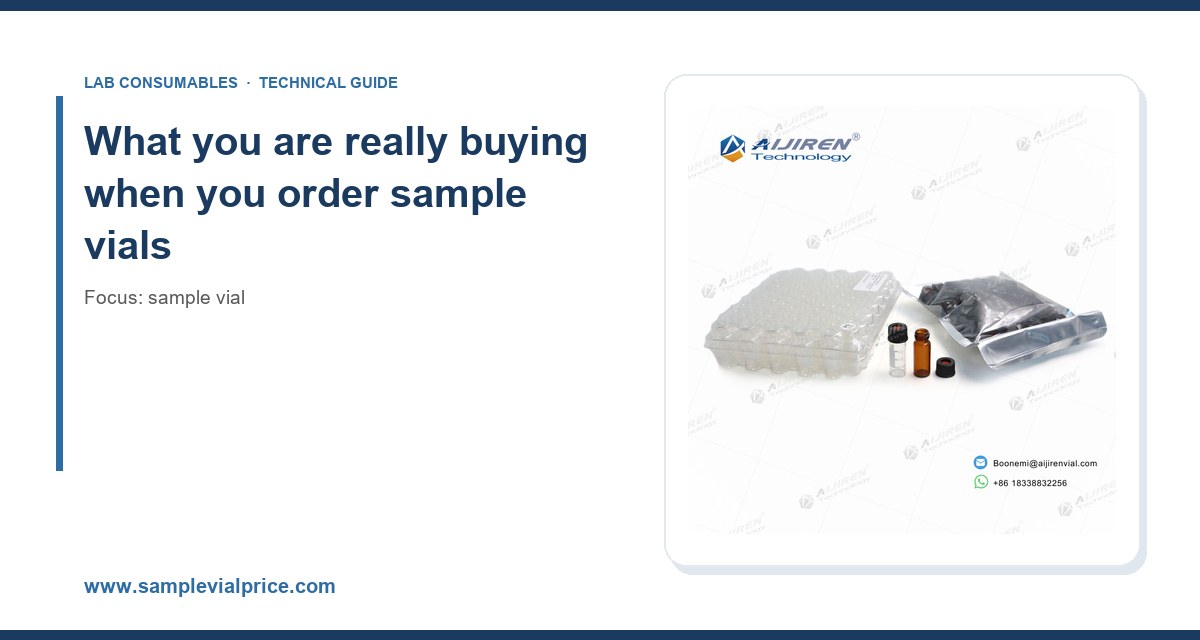
I have bought sample vials in quantities ranging from two cases to two pallets a month, and I have watched a “cheap” vial order turn into a three-week instrument shutdown. The difference between a good and bad procurement decision is almost never the unit price on the quote. It is the cap torque that was never specified, the septa batch that leaked at 40 °C, or the MOQ that locked up $18,000 of working capital in glass nobody needed. Here is how I evaluate vial suppliers now, with the numbers I actually use.
A sample vial is a system, not a part. You are buying four components that must work together: the glass body, the neck finish, the closure, and the septum. Get any one wrong and the failure shows up downstream, usually as a peak that will not reproduce or a septum that coring-sheds silicone into your autosampler needle.
The glass body carries the most hidden cost. Borosilicate 33-expansion glass (often sold as “Type I” when it meets USP criteria) is what you want for HPLC and GC work. Soda-lime glass is cheaper and acceptable for some non-critical sample storage, but it leaches alkali ions and can adsorb basic analytes. For LC-MS work at low pH, I do not accept anything below USP Type I borosilicate, and I ask for the hydrolytic resistance test result at pH 7 and pH 4.5. If the supplier cannot produce a USP <660> report, that is the first strike.
The neck finish is where most buyers get burned. A 12 x 32 mm vial with a crimp neck is not interchangeable with a 12 x 32 mm screw-thread vial, and a GPI 8-425 thread is not the same as a GPI 13-425 thread. GPI stands for Glass Packaging Institute, and the number pair is thread diameter and thread pitch in millimeters. A 13-425 cap will not seal a 8-425 vial, and forcing it will crack the neck. I have seen a lab manager order 10,000 “12 x 32 screw top vials” and receive 8-425 bodies when the autosampler tray was set up for 13-425 caps. The order was correct per the PO. The PO was wrong.
The four dimensions that must match your instrument
- Body diameter: 12 mm for standard 2 mL HPLC vials, 11 mm for many GC autosampler positions, 6 mm for microvolume inserts.
- Height: 32 mm is the standard 2 mL screw and crimp height; 32 mm tall with a 12 mm body is the most common configuration in autosamplers.
- Neck finish: GPI 8-425, GPI 13-425, GPI 10-425, or crimp (11 mm, 20 mm). Match to your autosampler tray and your existing cap inventory.
- Insert cavity: 150 µL, 250 µL, or 300 µL pulled-point inserts; conical or flat-bottom. A 250 µL insert in a 12 x 32 vial leaves roughly 100 µL of dead volume below the needle path.
If you are standardizing across multiple instruments, the Sample Vial catalog is organized by neck finish and body dimension, which saves you the spreadsheet reconciliation I used to do by hand. Pair that with the closure and septum data from Vials With Caps and you can build a single SKU list that covers most of your HPLC and GC positions.
How sample vial pricing actually breaks down
Most quotes you receive are quoted per case of 100. The per-unit price is a distraction. What matters is the landed cost per injection, which includes the vial, the cap, the septum, the insert (if used), and the labor to assemble them. A vial at $0.18 with a separate cap at $0.12 and a septum at $0.06 is a $0.36 assembly. A pre-assembled vial-and-cap at $0.34 is cheaper and saves you the assembly step. I have run this math on every line item for years, and the pre-assembled option wins more often than not once you count technician time at $35 to $55 per hour.
Typical 2024–2025 price bands (USD, per case of 100)
| Configuration | Glass | Typical price band | Notes |
|---|---|---|---|
| 2 mL, 12 x 32 mm, screw top, 8-425, no cap | Type I borosilicate | $14–$22 | Volume tier below 50 cases adds 10–15% |
| 2 mL, 12 x 32 mm, screw top, 13-425, no cap | Type I borosilicate | $16–$26 | 13-425 is the most common HPLC format |
| 2 mL, 12 x 32 mm, crimp top, 11 mm | Type I borosilicate | $18–$30 | Crimp tooling adds setup cost |
| 2 mL screw vial with 13-425 cap and PTFE/silicone septum, pre-assembled | Type I borosilicate | $28–$42 | Best value for high-throughput labs |
| 150 µL pulled-point insert, glass | Type I borosilicate | $22–$38 | Conical bottom; check needle depth |
| 300 µL insert, glass | Type I borosilicate | $26–$44 | Larger dead volume, fewer injections per vial |
These bands move with glass availability and freight. In 2022, borosilicate tubing shortages pushed some 2 mL vial prices up 30% in a single quarter. Suppliers who held contracts with domestic glass tubing plants did not pass that through. Suppliers who bought on the spot market did. Ask your supplier where the tubing comes from and whether they have a contracted allocation. That one question tells you more about price stability than any discount schedule.
What drives the MOQ
MOQ is a function of the supplier’s packaging line, not your needs. A manufacturer running a 10,000-piece-per-hour forming line cannot economically stop to run 200 vials. Typical MOQs I see:
- Manufacturer direct: 50 to 200 cases (5,000 to 20,000 vials) per SKU, often with a mixed-pallet option across 4 to 6 SKUs.
- Distributor with stock: 1 to 10 cases, at a 15 to 25% premium over manufacturer pricing.
- Private-label / custom print: 500 to 1,000 cases, plus a one-time plate charge of $400 to $900.
The trap is the “MOQ discount” that pushes you into 200 cases when your annual consumption is 60. Glass has a shelf life in practice: the longer it sits, the more likely the packaging gets crushed and the septa oxidize. I have opened a two-year-old case of PTFE/silicone septa and found the silicone layer had bonded to the liner. That is a $0.05 septum that cost me a $2,000 rerun. Buy to a 90-day supply, not a 12-month one, unless you have climate-controlled storage below 25 °C and 50% RH.
How to evaluate a sample vial supplier
I use a five-part scorecard. It takes about two hours to fill out and it has saved me from two bad suppliers in the last decade.
1. Dimensional and material documentation
Ask for a certificate of analysis (CoA) that lists body diameter, height, neck finish, glass type, and hydrolytic resistance. A real CoA has measured values, not just “conforms.” I want to see diameter within ±0.2 mm and height within ±0.5 mm. Anything looser and your autosampler gripper will start dropping vials. For septa, I want the durometer (typically 45 to 55 Shore A for silicone) and the PTFE liner thickness (0.2 to 0.25 mm is standard; thinner liners puncture through faster).
2. Septa performance under your actual conditions
The septum is the cheapest component and the most common failure point. A 13-425 screw cap with a PTFE/silicone septum should survive 50 to 100 punctures at a 22-gauge needle before coring becomes a problem. I test this myself: 20 vials, 75 injections each, and I count visible cores under a 10x loupe. If I see more than two cores per 100 punctures, I reject the lot. For GC headspace work at 80 to 120 °C, I switch to a PTFE-faced silicone or a molded PTFE septum, because standard silicone bleeds siloxanes that show up as ghost peaks at m/z 73, 147, and 207.
Temperature rating matters. Standard silicone/PTFE septa are rated to about 200 °C for short excursions but degrade above 150 °C in continuous use. For high-temperature GC, I use a septum rated to 300 °C and I confirm the rating in writing. The Restek technical resources library has good reference data on septum bleed and temperature limits that I have used to justify the upgrade to finance.
3. Cap torque and seal integrity
This is the spec nobody puts on a PO and everybody regrets. For a 13-425 screw cap with a PTFE/silicone septum, the correct torque is 0.5 to 0.8 N·m (about 4.4 to 7.1 inch-pounds). Below 0.4 N·m you get evaporative loss; above 1.0 N·m you deform the septum and create a channel. I use a calibrated torque screwdriver and check 10 caps per lot. If your lab does not own a torque screwdriver, buy one for $80. It is the cheapest insurance you will ever buy.
For crimp vials, the crimper jaw setting matters more than torque. An 11 mm crimp should produce a uniform crimp with no more than 0.1 mm variation around the circumference. I check with a crimp gauge and reject any lot where the seal fails a dye penetration test (I use a 0.1% methylene blue solution, 5 minutes, then inspect for wicking).
4. Supply chain and lead time
Ask three questions: Where is the glass formed? Where is the vial assembled and packaged? What is the current lead time and the last 12 months’ on-time delivery rate? A supplier who cannot answer the first two is a trader, not a manufacturer. That is not automatically disqualifying, but it changes your risk profile. I keep one manufacturer-direct supplier and one distributor for exactly this reason. The distributor costs 20% more and ships in 48 hours. The manufacturer is 30% cheaper and ships in 4 to 6 weeks. Both have a place in my purchasing plan.
5. Quality system and traceability
ISO 9001 is the floor. For regulated work (pharma, clinical, environmental under U.S. EPA SW-846), I want lot traceability from glass tubing batch to finished case, plus a retained sample program. If a lot fails, I need to know which instruments ran on it and which samples need re-analysis. A supplier who cannot trace a lot number back to a manufacturing date and a glass batch is a supplier I will not use for regulated methods.
Comparison checklist: manufacturer direct vs. distributor
| Criterion | Manufacturer direct | Distributor |
|---|---|---|
| MOQ | 50–200 cases per SKU | 1–10 cases |
| Unit price (2 mL, 13-425, no cap) | $16–$22/case | $20–$28/case |
| Lead time | 4–6 weeks | 48 hours to 1 week |
| Custom print / private label | Yes, 500+ cases | Rarely |
| CoA with measured values | Standard | On request, 3–5 days |
| Lot traceability | Full | Partial |
| Best for | High-volume, stable methods | Spikes, new methods, small labs |
My rule: if a SKU consumes more than 40 cases a year, go manufacturer direct. If it consumes fewer than 10, stay with a distributor. Between 10 and 40, run the math on carrying cost (about 20 to 25% of inventory value per year) and decide.
Selection criteria with numbers
When I write a vial specification, it looks like this. Copy it and adapt it.
- Glass: USP Type I borosilicate, hydrolytic resistance per USP <660>, pH 7 and pH 4.5 results on file.
- Dimensions: 12.0 ±0.2 mm diameter, 32.0 ±0.5 mm height, neck finish GPI 13-425.
- Septa: PTFE-faced silicone, 0.25 mm PTFE, 45–55 Shore A, rated to 200 °C continuous, 50+ punctures at 22G.
- Cap torque: 0.5–0.8 N·m for 13-425 screw caps; crimp uniformity ±0.1 mm for 11 mm crimp.
- Cleanliness: no visible particulates at 10x; background < 5 mAU at 210 nm in a blank injection.
- Packaging: 100 vials per case, double-bagged, with lot number on inner and outer labels.
For method development work, I also ask for a sample of 10 vials from the exact lot I will receive, not a “representative” sample pulled from a different batch. The difference between a qualification sample and a production lot has burned me twice.
Operational precautions that affect your cost per injection
Even a perfect vial fails in the wrong hands. Three things I enforce in my own lab:
- Never re-torque a cap after puncture. Once the septum is pierced, re-tightening creates a leak path. Use a fresh cap if you need to re-seal.
- Store septa below 25 °C and 50% RH. Silicone absorbs volatiles from the air. A septum stored next to a solvent cabinet will show ghost peaks for weeks.
- Do not mix cap and vial brands unless you have verified the fit. A 13-425 cap from one supplier may have a different liner thickness than another, changing the effective seal. I standardize on one cap-vial pair per method and I do not substitute without a re-validation.
If you are running a multi-instrument lab, the Chromatography Products index is a useful cross-reference for matching vials to autosampler models. The Agilent GC columns and accessories documentation and the Thermo Fisher chromatography and sample handling pages both list vial and cap compatibility by instrument, and I check them before I commit to a new SKU.
Troubleshooting checklist: when vials are the suspect
Before you blame the column, run this list. I have found the root cause here more times than I can count.
- Peak area RSD > 2% across replicates? Check cap torque first. A loose cap loses 1 to 3% of volume to evaporation in 24 hours at room temperature.
- Ghost peaks at m/z 73, 147, 207? Septum bleed. Switch to a PTFE-faced or molded PTFE septum and re-run the blank.
- Needle bending or autosampler errors? Vial height out of spec or insert seated too high. Measure 10 vials with calipers; reject the lot if height varies more than 0.5 mm.
- Sample loss at low volume (< 100 µL)? Insert dead volume. Switch to a 150 µL pulled-point insert and confirm needle depth reaches the bottom 1 mm.
- Coring visible in the vial? Needle gauge too large for the septum, or more than 100 punctures. Switch to a 22G needle and a fresh septum every 50 injections.
- Adsorption of basic analytes? Soda-lime glass or insufficient silanization. Move to Type I borosilicate and request a silanized option for amines.
For manufacturers who want the full technical background on glass forming and septa chemistry, the Aijiren technical pages cover the manufacturing side in more detail than most suppliers will share.
Recommendation
Here is what I would do if I were setting up vial procurement from scratch today:
- Standardize on two SKUs: a 2 mL, 12 x 32 mm, 13-425 screw vial with a pre-assembled PTFE/silicone cap, and a 150 µL pulled-point insert for low-volume work. That covers about 85% of routine HPLC and GC positions.
- Qualify two suppliers: one manufacturer direct for the 40+ case SKUs, one distributor for spikes and new methods.
- Write the spec with numbers: the dimensional tolerances, torque range, septum rating, and puncture count above. Put them on the PO, not just in an email.
- Test every lot: 20 vials, 75 injections, count cores, check torque on 10 caps, run a blank at 210 nm. It takes 90 minutes and it catches the bad lots before they reach your instruments.
- Buy 90 days at a time: not 12 months. The carrying cost and the degradation risk outweigh the volume discount.
The cheapest vial is the one that does not cost you a rerun. Price per case is a starting point, not a decision. The suppliers worth keeping are the ones who will put a torque range and a puncture count on paper, trace a lot number back to a glass batch, and tell you honestly when their lead time slips. Everything else is a discount you will pay for later.
References & further reading
Related resources from our lab consumables network:
- Sample Vial at samplevialprice.com
- Chromatography Products at chromatographyselling.com
- Aijiren at aijirentech.com
- Vials With Caps at vialswithcaps.com
External references and standards: