
I still remember the first pallet of 2 mL vials I bought without asking for a dimensional drawing. The caps torqued to spec on our filling line, but about 3 percent of them leaked during transport because the thread pitch on the glass was 0.2 mm off from the closure we had standardized. That mistake cost us a week of rework and taught me a lesson I have applied to every sample vial procurement decision since: price per unit is the least interesting number on a quotation. What matters is the total cost of ownership, and that starts with knowing exactly what you are buying, how many you must buy, and whether the supplier can prove they can make it the same way next quarter.
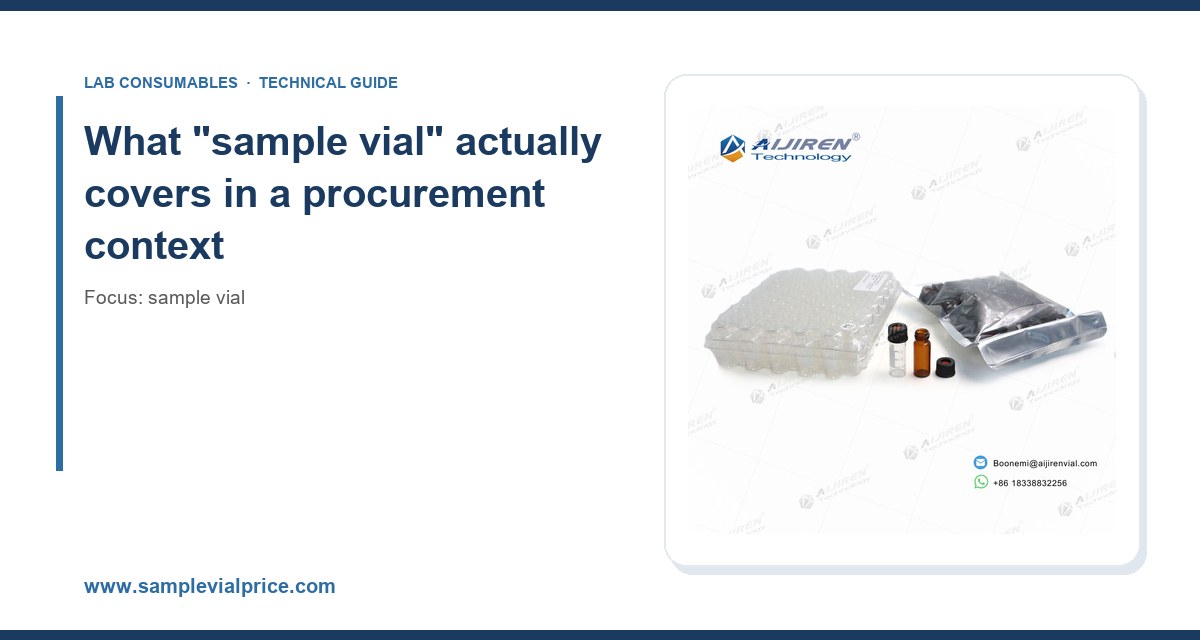
The term sample vial spans a wide range of products, and suppliers will happily quote you a low price on a SKU that is not interchangeable with what your method requires. Before you request quotes, pin down the specification. In my experience the categories below account for most of the spend in a typical analytical lab.
- 2 mL autosampler vials in 12 x 32 mm format, the workhorse of HPLC and GC autosamplers. Glass type, neck finish, and closure style vary enormously.
- 4 mL and 10 mL screw-thread vials for larger injection volumes or for storing standards.
- Headspace vials in 10 mL and 20 mL sizes with crimp or screw caps, rated for pressures up to about 2 bar at 80 °C in typical headspace samplers.
- Microvolume and deactivated inserts, typically 150 µL to 400 µL, used inside 2 mL vials when sample is scarce.
- Certified vials supplied with a certificate of analysis covering dimensional and cleanliness parameters, which many regulated labs now require.
The dimensional standard that matters most is the 12 x 32 mm format, which is nominally 12.0 mm outside diameter and 32.0 mm height. The neck finish for screw-thread vials is usually a 9 mm or 10-425 thread, and the two are not interchangeable. A 9 mm closure on a 10-425 vial will thread on but will not seal reliably. If you are unsure which format your autosampler expects, check the instrument manual or the vendor’s consumables catalog. Agilent publishes detailed dimensional data for its GC columns and accessories, and Thermo Fisher maintains similar reference material in its chromatography and sample handling documentation. Both are worth bookmarking before you write a spec.
Glass type and why it drives price more than anything else
Most 2 mL vials are made from one of three glass types, and the choice has a direct effect on both unit price and analytical performance.
Type I borosilicate glass
Type I borosilicate (often called borosilicate 3.3) has a low alkali content and a low coefficient of thermal expansion, about 3.3 x 10⁻⁶ /K. It is the default for HPLC and GC vials because it resists leaching of sodium and other ions into the sample. Expect to pay 15 to 30 percent more than for Type II or Type III glass, depending on volume and closure configuration. For trace analysis at the ppb level, that premium is not optional.
Type II and Type III soda-lime glass
Type II glass is soda-lime that has been surface-treated to reduce alkali leaching. Type III is untreated soda-lime. Both are cheaper, and both are perfectly adequate for many routine applications, but I have seen Type III vials produce sodium adducts in LC-MS and elevated blank peaks in trace GC. If your method has a low-level detection limit, do not compromise here.
Amber versus clear
Amber glass, usually made by adding iron oxide, protects light-sensitive analytes such as vitamins, certain pesticides, and many pharmaceutical compounds. It adds perhaps 5 to 10 percent to the unit price. For methods that run under yellow or red safe light, clear glass is fine. For anything stored on a bench under fluorescent lighting, amber is the safer choice.
Closures, septa, and the torque question
The closure is where most leaks and most analytical problems originate. A vial is only as good as the seal on top of it.
Screw caps versus crimp caps
Screw caps are the default for most modern labs because they are easier to apply consistently and do not require a crimping tool. Crimp caps, typically 11 mm or 20 mm aluminum, give a more reproducible seal when applied with a calibrated crimper, and they are still standard for headspace work. If you are buying screw caps, insist on a closure that is specified for your exact neck finish. The GPI 9 mm and GPI 10-425 finishes are the two you will encounter most; the Glass Packaging Institute publishes the GPI thread standards that define them.
Septa materials
Septa are the most under-specified component in most purchase orders. The common options are:
- Silicone, excellent resealing but prone to bleeding at high temperatures. Good up to about 200 °C in short exposures.
- PTFE-faced silicone, the standard for HPLC because the PTFE face is chemically inert. Puncture life is typically 3 to 5 injections per septum before coring becomes a risk.
- Butyl rubber, low bleed and good for headspace, but poor resealing after multiple punctures.
- PTFE/silicone with a slit, which reduces coring on autosamplers that use a side-port needle.
For a 2 mL vial with a 9 mm screw cap, a PTFE-faced silicone septum of about 1.0 mm thickness is the usual choice. Thinner septa (0.5 mm) are available for high-throughput work but puncture fewer times before leaking. If you are running 96-well plates or a high-volume autosampler, budget for septum replacement every few hundred injections, not every few thousand.
Torque values
Screw caps are usually applied with a torque of 0.5 to 1.0 N·m for 9 mm closures, and up to 1.5 N·m for 10-425. Over-torquing deforms the septum and can cause coring; under-torquing leaves a leak path. If you buy pre-capped vials, ask the supplier what torque their capping equipment uses and whether they verify it. A supplier who cannot answer that question is not a supplier you want for regulated work.
Pricing: what actually moves the number
Vial pricing is not a single number. It is a function of glass type, closure, septum, cleanliness grade, packaging, and order quantity. Here is how the components typically break down for a standard 2 mL clear glass vial with a 9 mm screw cap and PTFE/silicone septum.
| Configuration | Typical unit price (USD, 10k qty) | Notes |
|---|---|---|
| Type I clear, 9 mm screw, PTFE/silicone | 0.08 to 0.12 | Standard HPLC workhorse |
| Type I amber, 9 mm screw, PTFE/silicone | 0.09 to 0.14 | Light-sensitive analytes |
| Type I clear, certified (CoA) | 0.14 to 0.22 | Regulated labs, method validation |
| Type III clear, 9 mm screw | 0.05 to 0.08 | Routine work only |
| 20 mL headspace, crimp, butyl | 0.30 to 0.55 | Includes cap and septum |
| 150 µL insert, glass, deactivated | 0.25 to 0.60 | Microvolume work |
These are indicative ranges from my own purchasing experience in 2024 and 2025; your numbers will depend on region, freight, and whether you are buying direct or through a distributor. The point is not the exact figure but the spread. A 3x difference between the cheapest and most expensive configuration is normal, and the cheapest option is rarely the right one for a regulated method.
What drives the price up
- Certification and documentation. A certificate of analysis with dimensional and extractables data adds real cost, but it is what auditors want to see.
- Cleanliness grade. Vials washed and packed in a controlled environment cost more than bulk-packed vials. For LC-MS work at low ng/mL levels, the difference shows up in your blanks.
- Packaging. Vials packed in a clean-room bag with a tamper-evident seal cost more than those in a simple poly bag. If your lab has a documented contamination control procedure, this matters.
- Closure assembly. Pre-capped vials (cap and septum already assembled) save labor but add cost. For high-throughput labs the labor saving usually wins.
What drives the price down
- Volume. The price curve flattens quickly. Going from 1,000 to 10,000 units might cut unit price by 30 percent; going from 10,000 to 100,000 might cut it by another 15 percent. Beyond that, the savings are marginal.
- Standardization. If you can standardize on one or two SKUs across your lab, you get better pricing than if you order a long tail of variants.
- Direct sourcing. Buying from a manufacturer rather than a distributor typically saves 10 to 20 percent, at the cost of longer lead times and less local support.
MOQ: how to negotiate it without getting stuck with inventory
Minimum order quantities are where procurement and lab reality collide. A manufacturer may quote an MOQ of 50,000 units to get the best unit price, but your lab may only use 5,000 a year. The result is a pallet of vials that sits in the stockroom until the glass yellows.
My rule of thumb is to target 6 to 12 months of consumption per order. That balances price against shelf life and storage. Sample vials do not expire in the way reagents do, but packaging and cleanliness degrade over time, and a two-year-old box of “clean” vials is not clean anymore.
Negotiation tactics that actually work
- Ask for a price break schedule. Most suppliers have one; they just do not volunteer it. Ask for the price at 1k, 5k, 10k, 25k, and 50k units.
- Offer a blanket order with scheduled releases. A commitment to buy 50,000 units over 12 months, released in quarterly shipments, often gets you the 50k price with the 12.5k inventory.
- Bundle SKUs. If you buy vials, caps, and septa from the same supplier, you have leverage. The vials with caps range is a good example of how bundling simplifies both purchasing and inventory.
- Ask about “sample” quantities. Many suppliers will ship 500 to 1,000 units at near cost for evaluation. Use this to run a real comparison before you commit.
How to evaluate a supplier: a decision checklist
This is the part most procurement teams skip. They compare price per unit and lead time, then pick the cheapest. That works until the first bad lot, and then it costs far more than the savings. Here is the checklist I use, with concrete thresholds.
1. Dimensional and material compliance
- Does the supplier provide a dimensional drawing with tolerances? For a 12 x 32 mm vial, expect ±0.2 mm on diameter and ±0.3 mm on height.
- Is the glass type stated on the certificate? “Borosilicate” alone is not enough; you want Type I borosilicate 3.3 if that is what your method requires.
- Are the thread finish (GPI 9 mm or 10-425) and closure compatibility documented?
2. Cleanliness and extractables data
- Does the supplier provide extractables data, ideally by LC-MS and GC-MS, showing low background at your detection level?
- Is there a certificate of analysis per lot, or only per shipment? Per-lot is what you want for regulated work.
- Can they supply a sample of the actual production lot for your own blank testing? Always run your own blanks; supplier data is a starting point, not a substitute.
3. Manufacturing and quality systems
- Is the supplier ISO 9001 certified? For pharmaceutical work, look for ISO 15378 (GMP for primary packaging).
- Do they have in-house dimensional inspection, or do they rely on the glass manufacturer? In-house is better.
- What is their lot traceability? You should be able to trace a box of vials back to the glass batch and the capping run.
4. Capacity and lead time
- What is their stated lead time, and what is their on-time delivery record? Ask for a number, not a promise.
- Do they hold safety stock of your SKU, or is every order made to order? Made-to-order is fine for large volumes but painful for urgent top-ups.
- Can they scale if your consumption doubles? A supplier who cannot scale is a future supply risk.
5. Commercial terms
- What is the MOQ, and is it negotiable with a blanket order?
- What are the payment terms? Net 30 is standard; net 60 is worth asking for on large orders.
- What is the return policy for non-conforming lots? Get this in writing.
Troubleshooting: when a new supplier’s vials cause problems
Even a supplier that passes every check can ship a lot that misbehaves. Here is the checklist I run through when a new lot causes trouble, in the order I check things.
- Leaks at the closure. Check torque first. Then check thread finish compatibility. Then check septum thickness and durometer. A septum that is too soft will cold-flow under torque and leak after a few hours.
- Elevated blanks. Run a blank with the new vials and the old vials side by side. If the new vials show peaks, the problem is cleanliness or glass type. Request extractables data for the lot.
- Autosampler errors. Check dimensional tolerance. A vial that is 0.5 mm too tall will jam a carousel; one that is 0.3 mm too narrow will wobble and cause needle misses. Measure a sample of 20 vials with calipers and compare to the drawing.
- Coring and needle damage. Inspect septa after a run. If you see a plug of septum in the vial, the needle is coring. Switch to a pre-slit septum or a softer silicone.
- Adsorption of analytes. Some compounds, especially proteins and certain pesticides, adsorb to untreated glass. Use deactivated vials or silanized glass for these methods.
If you are running methods under U.S. EPA SW-846, the method documentation often specifies vial and septum requirements. Read it before you change suppliers; a cheaper vial that fails the method’s quality control checks is not cheaper at all. Restek’s technical resources are also useful for cross-checking septum and liner recommendations against your method.
Where to source and how to structure the relationship
There are three sourcing models, and each fits a different situation.
Direct from manufacturer
Best for high volume and for labs that need custom specifications. Lead times are longer, and you lose the local support a distributor provides, but the unit price is typically 10 to 20 percent lower. If you are buying more than 50,000 units a year, this is usually the right model. Manufacturers such as Aijiren supply both standard and custom configurations and can provide the documentation regulated labs need.
Through a distributor
Best for labs that buy a wide range of consumables and value one-stop ordering and local stock. You pay a premium, but you get shorter lead times and a single point of contact for returns. For labs buying under 20,000 units a year, the distributor premium is often worth it.
Hybrid: standard SKUs direct, specialty through distribution
This is what I recommend for most mid-sized labs. Standardize on two or three high-volume SKUs and buy them direct on a blanket order. Buy the long tail (inserts, specialty septa, headspace vials) through a distributor who stocks them. You get the price benefit where it matters and the flexibility where you need it.
Whichever model you choose, keep a current specification sheet on file for every SKU you buy, and review it annually. Specifications drift, and a supplier who met your spec three years ago may not meet it today. The sample vial range is a good place to start comparing configurations and building that spec sheet, and the broader chromatography products catalog is useful for cross-referencing closures and septa.
A worked example: what a real evaluation looks like
Suppose your lab runs 40,000 injections a year on a single HPLC system, using 2 mL clear vials with 9 mm screw caps. Your current supplier charges $0.12 per vial. A new supplier quotes $0.09. On the face of it, that is a $1,200 annual saving. Here is how I would evaluate it.
- Request 1,000 units for evaluation. Run 200 injections with the new vials and 200 with the current vials, alternating, and compare peak area RSD. A difference of more than 0.5 percent RSD between the two groups is a red flag.
- Run blanks. Inject 10 blanks from each group. Any peak above your method’s reporting limit in the new-vial blanks means the cleanliness grade is not adequate.
- Measure 20 vials from each lot with calipers. Check diameter, height, and neck finish against the drawing. Reject the lot if more than 2 percent are out of tolerance.
- Check septum performance. Run 100 injections through a single septum and inspect for coring. If it cores before 50 injections, the septum is too thin or too soft.
- Calculate total cost. Add the cost of any rework, the labor to investigate a failed lot, and the risk of a method failure during an audit. A $0.03 saving per vial can disappear quickly if one lot fails.
If the new supplier passes all of these, the saving is real. If it fails any one of them, the saving is an illusion. In my experience, roughly one in three cheaper suppliers passes this evaluation. The other two are not worth the trouble.
Takeaway
Sample vial procurement is not a price negotiation. It is a specification exercise. Define the glass type, the neck finish, the septum, the cleanliness grade, and the documentation you need before you ask for a quote. Then negotiate MOQ against a realistic consumption forecast, and evaluate every new supplier against a written checklist with concrete thresholds. The suppliers who can answer your questions about torque, tolerances, and extractables are the ones worth keeping. The ones who cannot are a future lot failure waiting to happen, and no unit price is low enough to make that worthwhile.
References & further reading
Related resources from our lab consumables network:
- Sample Vial at samplevialprice.com
- Chromatography Products at chromatographyselling.com
- Aijiren at aijirentech.com
- Vials With Caps at vialswithcaps.com
External references and standards: