
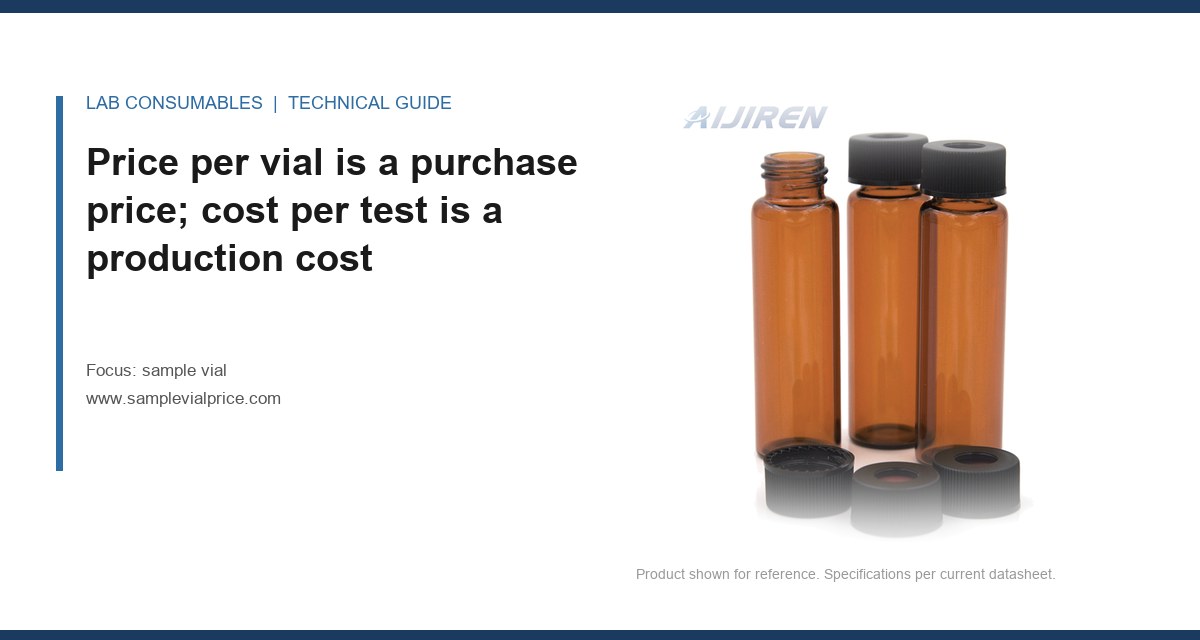
A 96-position autosampler run on a two-week-old lot of 9 mm vials came back with 11 injections flagged for low area, all clustered in positions 60 through 71. The analyst pulled the septa and found the same defect on every one: a 1.1 mm core punched clean through the 3 mm silicone layer, straight into the headspace. The vials cost $0.14 each. The rerun cost $340 in instrument time, $90 in standards, and half a shift of a chemist’s day. That is the entire argument for calculating sample vial cost per test instead of comparing price per unit, and it is the calculation most procurement spreadsheets still skip. I have watched a $0.03-per-unit saving turn into a $2.40-per-reported-result penalty on the same method, and I have watched a $0.09 premium pay for itself in four weeks. This piece is about how to run that number yourself, with the rerun rate, the reject rate, and the prep time all sitting in the denominator where they belong.
A vial on a purchase order is one thing. A vial that produced a reported, defensible result is another. Between those two states sit four cost pools that never appear on the invoice: the consumables consumed by a rerun, the labor spent preparing a sample that gets rejected, the instrument capacity tied up while a failed injection repeats, and the QA review that a rerun triggers. For a typical HPLC or GC-MS method running 40 to 80 samples a day, the vial itself is 2 to 6 percent of the per-test cost. The rerun rate is 30 to 70 percent. That ratio is why the unit price is a weak proxy and why the calculation below is worth doing once per method and revisiting whenever you change grades.
The formula I use is deliberately blunt:
Cost per reported result = (vial unit price × vials consumed per reported result) + (rerun cost × rerun rate) + (reject cost × reject rate) + (prep labor per vial × prep minutes ÷ 60) + (instrument time per injection × hourly rate ÷ 60)
Every term is measurable. None of them require a statistician. The trap is that most buyers measure the first term and estimate the rest from memory, and memory is generous. Get the rerun rate from the LIMS or the CDS audit trail, not from the analyst’s recollection. Get the reject rate from the QC log. Get the prep minutes from a time study on ten samples, not from the SOP’s stated duration.
The rerun rate is the number that actually moves the answer
Reruns come from three places, and only one of them is the vial’s fault. The first is a genuine vial or septum failure: a coring event, a loose cap that vented during a heated headspace run, a non-certified vial whose extractable profile threw a ghost peak into the quantitation window. The second is sample prep error, which the vial can influence through adsorption, dead volume, or poor sealing. The third is instrument drift, which has nothing to do with the vial and everything to do with the column and the detector.
If you attribute the whole rerun rate to the vial, you will overpay for glass. If you attribute none of it, you will underpay and the lab will absorb the difference in overtime. I split the rerun rate into attributable and non-attributable using the failure code on the rerun ticket. On a typical 40-sample method, a 4 percent overall rerun rate might break down as 1.6 percent vial-attributable, 1.1 percent prep-attributable, and 1.3 percent instrument. Only the first two belong in the vial cost calculation. The instrument portion belongs in a different budget line, and pretending otherwise is how a procurement team “proves” that switching to the cheap vial saves money.
What a coring event actually costs
A cored septum is not just a failed injection. On a 9 mm screw-thread vial with a 1 mm PTFE-faced silicone septum, a 22-gauge needle should puncture cleanly 5 to 8 times before the silicone begins to tear. A blunt or burred needle, or a septum with a hard silicone layer above 55 Shore A, will core on the second or third puncture. When it cores, the silicone plug can fall into the sample, the headspace seal fails, and on a heated headspace method at 80 °C the loss of seal produces a low-area result that looks like a sample problem. The rerun cost is the injection time plus the standard re-preparation plus the review. On a GC-MS with a 22-minute run, that is roughly $18 to $26 per rerun once you load the instrument hourly rate. Multiply by the number of coring events per 1,000 injections and you have the vial-attributable rerun cost.
Rejects are a prep-time problem disguised as a vial problem
A rejected sample never reaches the instrument, so it does not show up in the rerun rate. It shows up as a sample that was prepared, capped, labeled, and logged, then thrown away because the cap did not seal, the fill volume was wrong for the vial’s actual capacity, or the label would not survive the autosampler tray. The cost of a reject is the full prep labor plus the fraction of the sample that is now gone. For a method that requires 2 mL of a limited biological sample, a reject can mean the test cannot be repeated at all, which is a different and much worse cost.
I have seen reject rates as high as 6 percent on a lot of vials whose crimp neck dimensions drifted 0.3 mm outside the GPI 9 mm specification. The symptom was caps that seated but did not seal, and the measurement that caught it was a go/no-go gauge on the crimp diameter across 30 vials from the lot. The fix was a lot rejection and a supplier conversation, but the cost of the rejects in the interim was already sunk. That is why the reject rate belongs in the per-test calculation and why incoming dimensional checks on a sample of 30 are cheap insurance.
Prep time per vial is small per unit and large per thousand
An analyst who spends 45 seconds uncapping, filling, capping, and labeling a vial is spending 12.5 hours per 1,000 vials on that step alone. At a fully loaded $65 per hour, that is $812 per 1,000 vials, or $0.81 per vial in labor. Compare that to a vial unit price of $0.14. The labor is nearly six times the glass. This is the term that buyers ignore and that lab managers feel every day.
Vial design changes prep time in ways that are easy to measure and hard to predict. A vial with a wider 40 percent opening and a pre-assembled cap-and-septum reduces the capping step to a quarter-turn, which I have timed at 18 seconds versus 45 for a separate cap and septum. Over 1,000 vials that is 7.5 hours saved, or about $487. A vial with a fill line and a graduated body reduces the volume-check step. A vial with a consistent 12 × 32 mm body feeds through the autosampler without a jam, and a jam costs 4 to 6 minutes of recovery plus the risk of a bent needle. None of these appear in a per-unit price comparison. All of them belong in the per-test calculation.
Two grades, one table, and the number that decides it
The comparison below uses a 2 mL clear glass 9 mm screw-thread vial, the most common format in HPLC and GC autosamplers, and it compares a commodity grade against a certified grade with a documented extractables profile. The assumptions are stated so you can substitute your own: 40 samples per day, 250 working days, $65 per hour loaded labor, $120 per hour instrument time, 22-minute run, 45 seconds prep per vial on commodity and 30 seconds on certified (pre-assembled cap), 4 percent overall rerun rate of which 1.6 percent is vial-attributable on commodity and 0.6 percent on certified, and a 6 percent reject rate on commodity versus 1 percent on certified.
| Cost term | Commodity grade | Certified grade |
|---|---|---|
| Vial unit price | $0.11 | $0.20 |
| Vials consumed per reported result (incl. rejects) | 1.064 | 1.010 |
| Consumable cost per result | $0.117 | $0.202 |
| Vial-attributable rerun rate | 1.6% | 0.6% |
| Rerun cost per result (at $26 per rerun) | $0.416 | $0.156 |
| Reject rate | 6.0% | 1.0% |
| Reject cost per result (prep labor + lost sample) | $0.372 | $0.062 |
| Prep labor per result (at $65/hr) | $0.812 | $0.542 |
| Instrument time per result (at $120/hr) | $0.440 | $0.440 |
| Cost per reported result | $2.16 | $1.40 |
| Annual cost at 10,000 results | $21,600 | $14,000 |
The certified vial costs 82 percent more per unit and 35 percent less per reported result. The swing is $7,600 a year on a single method. If that number surprises you, it is because the commodity price was doing all the talking. The certified grade wins here not because it is better glass but because its documented septum hardness and dimensional consistency cut the two failure-driven cost pools. Change the rerun rate on the commodity grade to 0.8 percent and the gap narrows to about $3,100. Change it to 2.5 percent and the gap widens past $12,000. The decision is sensitive to the rerun rate, which is why measuring it is the first task, not the last.
Where the grade boundary actually sits
Certified grade is not automatically the right answer. On a method that runs aqueous standards with a clean matrix and a 0.5 percent rerun rate, the commodity vial’s cost per result is within 12 percent of the certified vial and the extra spend buys nothing you can measure. The boundary I use is a rerun rate above 1.2 percent attributable to the vial, or any method where a single rerun costs more than 20 times the unit price difference. Below that, buy the commodity vial, but buy it with an incoming dimensional check and a septum hardness specification. Above it, buy the certified grade and stop arguing about the unit price.
There is a third case that the table does not capture: methods where the sample cannot be repeated. If the sample is a 1 mL aliquot of a clinical or environmental specimen, a reject is not a cost, it is a lost result. In that case the reject rate dominates everything, and I would pay $0.40 per vial without blinking if it moved the reject rate from 6 percent to 1 percent. The per-test calculation still applies, but the reject cost term has to include the value of the lost sample, not just the labor.
Two field cases where the per-test number changed the purchase
Case 1: the 80 °C headspace method that vented
A GC headspace method running at 80 °C with a 20-minute equilibration was showing a 3.4 percent rerun rate, all on the last 15 positions of a 60-vial tray. The symptom was low area and a shoulder on the internal standard peak. The measurement that identified it was a pressure-decay test: 20 vials were capped, pressurized to 15 psi, and the pressure loss over 10 minutes was logged. Eleven of the 20 lost more than 0.5 psi, and all eleven came from the same lot. The cause was a cap with a 0.08 mm undersized crimp skirt that relaxed at temperature. The fix was a switch to a certified crimp cap with a documented seal rating to 100 °C and a torque check on the crimper at 12 inch-pounds. The rerun rate dropped to 0.7 percent, and the cost per result fell from $2.41 to $1.52. The vial unit price went up by $0.06. The annual saving on 8,000 results was about $7,100.
Case 2: the autosampler jam that was a dimensional problem
A 96-position autosampler was jamming 2 to 3 times per 500 injections, each jam costing 5 minutes of recovery and once bending a needle at $180. The symptom was a vial that sat 0.4 mm high in the tray. The measurement was a height check across 50 vials from three lots: the offending lot had a body height of 32.4 mm against a nominal 32.0 mm, outside the 12 × 32 mm tolerance. The fix was a lot return and a supplier requirement for a 32.0 ± 0.15 mm body height with a certificate of analysis per lot. The jam rate fell to zero over the next 3,000 injections. The per-test saving was small, about $0.03, but the needle replacement and the downtime came off the books entirely. This is the kind of cost that never appears in a unit price comparison and always appears in the lab’s overtime line.
A troubleshooting checklist for a per-test number that looks wrong
If your calculated cost per reported result comes out lower than the lab’s actual spend per result, one of these is usually the reason. Work through them in order.
- Rerun rate measured from memory. Pull it from the CDS audit trail or LIMS over at least 1,000 injections. A 200-injection window is too noisy to separate 1 percent from 2 percent.
- Reject rate missing entirely. Check the prep bench log, not the instrument log. Rejects never reach the instrument.
- Prep time taken from the SOP. Time ten samples with a stopwatch. The SOP says 30 seconds; the bench says 45 to 60.
- Instrument hourly rate understated. Include the service contract, the column amortization, and the facility cost, not just the operator.
- Vial-attributable reruns not separated from instrument drift. Use the failure code on the rerun ticket. If there is no failure code, that is the first fix.
- Lot-to-lot variation hidden by averaging. Calculate the per-test number per lot, not per year. A single bad lot can carry a 6 percent reject rate while the annual average looks like 2 percent.
- Septum hardness not specified. Ask for the Shore A value and the puncture count to failure. A 55 Shore A silicone with a PTFE face should give 5 to 8 clean punctures with a 22-gauge needle.
- Crimp or thread dimensions not checked on receipt. A go/no-go gauge on 30 vials per lot catches the drift before it reaches the tray.
For method-specific container requirements, the U.S. EPA SW-846 test methods set the container and preservation rules that drive vial selection for environmental work, and the instrument vendors publish the autosampler dimensional tolerances that drive the rest. Agilent’s GC columns and accessories documentation and Thermo Fisher’s chromatography and sample handling pages both list the tray and needle specifications you need for the dimensional check. Restek’s technical resources are a useful cross-check on septum selection and puncture life.
The decision rule I would put in the purchasing policy
Calculate cost per reported result for each candidate grade on the actual method, using measured rerun and reject rates, and buy the grade with the lowest number, not the lowest unit price. Set the threshold at a vial-attributable rerun rate of 1.2 percent: below it, the commodity vial is defensible if you enforce a dimensional check and a septum hardness spec on receipt; above it, move to the certified grade and stop negotiating the unit price. Re-run the calculation whenever the method, the autosampler, or the supplier changes, and calculate it per lot rather than per year so a single bad shipment cannot hide inside an annual average. The vial is a small line item. The cost per reported result is the one the lab actually pays, and it is the only number worth putting in front of a procurement committee.
If you are sourcing the vial itself, the sample vial catalog at samplevialprice.com lists the dimensional and septum specifications you need for the calculation, and the vials with caps range covers the pre-assembled formats that cut prep time. For the wider consumables picture, chromatography products at chromatographyselling.com and the manufacturing background at Aijiren are worth a look before you lock a grade into a contract.
References & further reading
Related resources from our lab consumables network:
- Sample Vial at samplevialprice.com
- Chromatography Products at chromatographyselling.com
- Aijiren at aijirentech.com
- Vials With Caps at vialswithcaps.com
External references and standards: