
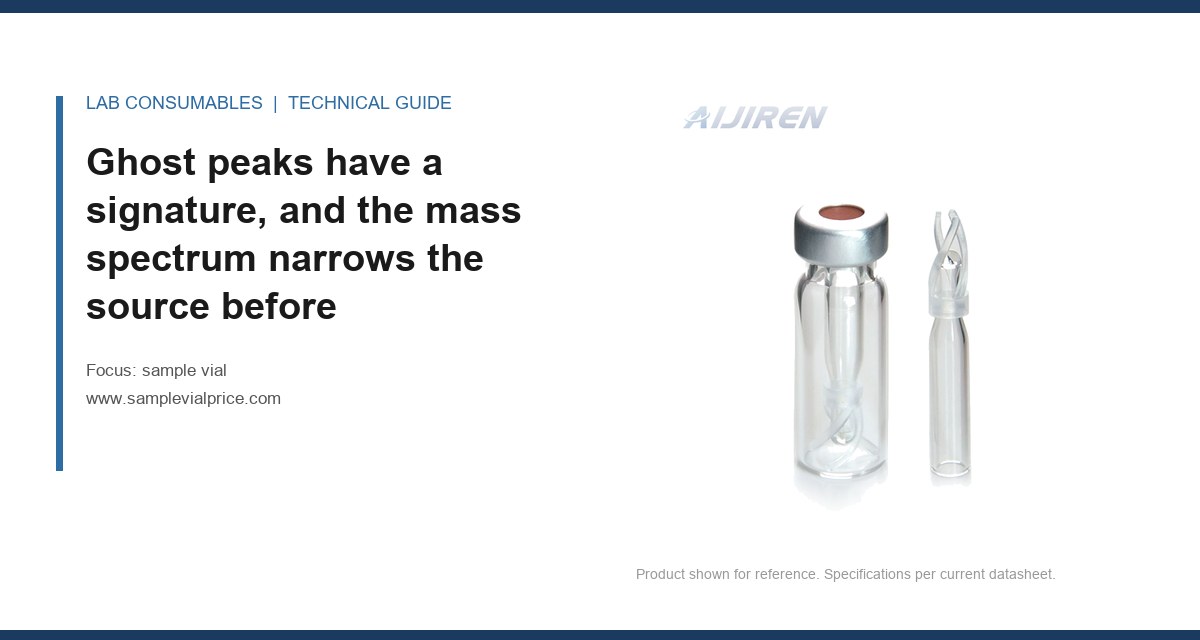
A 60 m × 0.25 mm × 0.25 µm DB-5MS column that had run clean for three weeks started throwing a 0.8 to 1.4 pA rise in the baseline between 22 and 26 minutes, with three unassigned peaks at retention indices of 1180, 1240, and 1310. The method was a US EPA 8270 semivolatile run on a GC-MS. The instrument had just come back from PM. The column was new. The autosampler syringe was new. What changed was the vial lot: we had switched from a lot of 2 mL amber vials with PTFE-lined silicone septa to a lower-cost lot with a different liner construction, and nobody had run a blank on the incoming pallet. The ghost peaks were not from the column, the inlet, or the syringe. They were extractables from the septum, eluting as a slow bleed that the mass spec read as three broad humps of siloxane fragments at m/z 73, 147, 207, 281.
This is the part of sample vial troubleshooting that gets skipped, because the failure is invisible until you look for it. If you are chasing sample vial ghost peaks, extractables and contamination that appear without a sample, the source is almost always a polymer in the flow path that is being asked to do more than it was formulated to do. The work is to find out which polymer, at what temperature, and how to prove it with a blank and a placebo.
Ghost peaks have a signature, and the mass spectrum narrows the source before you touch the instrument
I stopped guessing at contamination sources about ten years ago, because the mass spec tells you the answer in the first scan. A ghost peak is not random. It carries a fingerprint of the material that released it, and that fingerprint points to a specific component.
What each fragment class tells you
- m/z 73, 147, 207, 221, 281, 327 in a repeating pattern: polydimethylsiloxane (PDMS). Septum, septa coating, silicone tubing, or a silicone-based lubricant. On a nonpolar column this is the single most common vial-related ghost.
- m/z 149, 167, 205, 279: phthalate esters, usually DEHP or DBP. Plasticizer from a vial cap liner, a plastic cap, a septa adhesive, or a plastic storage bag. DEHP boils around 385 °C and will sit on a column for a long time.
- m/z 57, 71, 85, 99 in a smooth envelope: long-chain hydrocarbon. Mold release agent, paraffin, or a lubricant film. Often from the vial body itself if the glass was handled after forming.
- m/z 91, 105, 119, 133: alkylbenzene or antioxidant fragments, typically BHT or Irganox-type compounds from a polymer stabilizer package.
- m/z 44, 58, 60 with a broad early peak: acetic acid, acetone, or a short-chain alcohol, often from a cleaning solvent residue or an adhesive cure byproduct.
Run the suspect vial through a full-scan injection with the column held at 40 °C for 2 minutes, then ramped at 10 °C/min to 300 °C. If the ghost peaks elute in that window and the library match is a siloxane or a phthalate, you have your polymer class. If they elute before 5 minutes, the source is volatile and probably a solvent or a low-molecular-weight residue, not a high-temperature extractable.
Why the temperature ramp matters more than the peak height
A vial that looks clean at 40 °C can be a disaster at 250 °C. Extractables are a function of temperature, contact time, and the surface area of polymer exposed to the sample or headspace. A 2 mL vial with a 9 mm septum has about 0.6 cm² of exposed silicone. That is small. But a septum that has been punctured five times by a 23-gauge needle has a torn, frayed surface with perhaps three times the exposed area, and the tear exposes the raw silicone core rather than the PTFE face. That is when the siloxane bleed starts.
Which polymer bleeds what, and at what temperature
This is the table I wish someone had handed me when I started. The numbers are from our own lot testing on GC-MS and from the published extractables work that Agilent, Restek, and Thermo publish for their consumable lines. Use them as a starting point, not a substitute for your own blank.
| Material | Typical use in a vial | Onset of measurable bleed | Dominant extractable | Practical note |
|---|---|---|---|---|
| Silicone (PDMS) septum | Standard 9 mm or 11 mm cap | ~180 °C in headspace; ~220 °C in direct injection | Cyclic siloxanes, m/z 73/147/207 | Cheapest, most common, and the number one ghost peak source above 200 °C |
| PTFE-faced silicone | Most general HPLC and GC caps | PTFE face holds to ~260 °C; silicone core bleeds once the face is punctured | Siloxanes after puncture; PTFE itself is inert to ~260 °C | Puncture count is the real limit, not temperature |
| Bonded PTFE/silicone (no adhesive) | Higher-temp GC, USP <621> work | ~250 to 280 °C | Reduced siloxane; some residual from the bonding process | Costs more; worth it for trace analysis above 250 °C |
| PTFE/silicone with a laminated film | Headspace and SPME caps | ~200 °C for the film; the film can delaminate | Adhesive residues, phthalates | Delamination is a mechanical failure but shows up as a ghost peak |
| Polypropylene (PP) cap or vial | Some 1 mL and 2 mL vials, caps | ~120 °C | Oligomers, antioxidants (BHT, Irganox 1010) | Fine for LC, not for hot GC injection |
| Polyethylene (PE) cap liner | Some screw caps | ~100 °C | Hydrocarbon waxes, slip agents (erucamide) | Shows up as a broad envelope at m/z 57/71/85 |
| Glass (Type I borosilicate) | Vial body | No organic bleed to 300 °C | None; risk is surface residue, not extractables | Glass is the inert part. The polymer is the problem. |
The takeaway: if your method injects at or above 250 °C, a standard PTFE-faced silicone septum will bleed siloxanes eventually, and the only question is how many punctures it takes. If your method runs at 150 °C or below, almost any septum is fine and you should look elsewhere for the ghost. That single temperature breakpoint answers 70 percent of the contamination questions I get.
Isolate the source with a blank, a placebo, and a vial-only injection
You cannot fix what you have not localized. The three-injection sequence below takes about 40 minutes and will tell you whether the ghost is from the vial, the cap, the septum, the sample, or the instrument. Run them in this order.
Injection 1: the system blank
Inject 1 µL of the same solvent you use for the sample, from a vial you have not opened, into the same inlet. If the ghost appears here, the vial is not the source. Look at the inlet liner, the septum on the inlet, the syringe, and the column. A siloxane ghost at m/z 73 from a system blank is almost always the inlet septum, not the sample vial.
Injection 2: the vial-only blank
Fill a fresh vial from the suspect lot with 1.5 mL of your solvent, cap it with a cap from the same lot, and inject. If the ghost appears here but not in injection 1, the vial or the cap is the source. This is the injection that most labs skip, and it is the one that catches a bad lot.
Injection 3: the placebo
Prepare a placebo that matches the sample matrix but contains no analyte. If the ghost appears in the placebo but not the vial-only blank, the source is the sample matrix reacting with the vial, not the vial itself. This is less common but real: a sample at pH 2 will leach metal ions from a low-quality glass and can catalyze degradation of a sensitive analyte.
What the three injections tell you
- Ghost in 1, 2, and 3: instrument source. Check the inlet septum, liner, and column.
- Ghost in 2 and 3, not 1: vial or cap. Run a lot-to-lot comparison (below).
- Ghost in 3 only: sample-matrix interaction. Check pH, ionic strength, and storage time.
- Ghost in 2 only: vial or cap, and the sample matrix is masking it. Run the extraction test.
For the vial lot comparison, pull 10 vials from the incoming lot and 10 from a known-good lot, fill each with solvent, cap, and inject. Compare the area of the largest ghost peak. A ratio above 3:1 between the two lots is a reject. I have seen ratios of 20:1 on a bad septum lot, and the vendor’s certificate of analysis said nothing because the CoA only tested dimensions.
Two field cases where the vial was the source and the instrument was not
Case 1: the phthalate that came from the cap, not the sample
A contract lab running EPA 8270 for a soil client kept seeing a 0.3 to 0.5 ppm DEHP hit in every blank and every sample, always at the same retention time, always with m/z 149 as the base peak. They replaced the column, the inlet liner, and the syringe. No change. They sent the solvent back to the supplier. No change.
The measurement that identified it: they ran a vial-only blank with a cap from the same box, then a vial-only blank with a cap from a different box of the same part number but a different manufacturing date. The first box gave 0.42 ppm DEHP equivalent; the second gave 0.04 ppm. The difference was the cap liner: the first box used a liner with a phthalate-plasticized adhesive, the second used a non-phthalate adhesive. The fix was to specify a cap with a PTFE-faced silicone septum bonded without phthalate plasticizer, and to add a lot-release blank injection to the incoming inspection for every cap lot. The ghost disappeared, and the lab now tests every incoming cap lot with a single injection before it goes into the cabinet.
Case 2: the siloxane ghost that only appeared on the fifth puncture
A pharmaceutical QC lab running a USP <621> method on a headspace GC was getting a siloxane ghost at m/z 207 that appeared only on samples from the back half of the autosampler tray. The first 20 vials in a run were clean; vials 21 onward showed the ghost. The instrument was fine. The method was fine.
The measurement that identified it: they logged the puncture count per vial position and found the ghost appeared at position 21, which was the first vial prepared with a cap that had already been punctured four times during a method-development run and then re-used. The lab had a practice of re-capping and re-injecting vials when a run was interrupted. The fifth puncture tore the PTFE face, exposed the silicone core, and the siloxane bleed started. The fix was a hard rule: one cap, one vial, one puncture, and a cap is never re-used after it has been punctured. They also moved to a bonded PTFE/silicone septum for the headspace method, which pushed the onset of bleed to ~250 °C and gave more margin. The ghost disappeared on the next run.
Both cases share a pattern: the ghost was not from the instrument, and the instrument was the first thing everyone checked. The vial and the cap are the last thing anyone checks, and they are the most common source above 200 °C.
A lot-release protocol that catches extractables before they reach the instrument
The only reliable defense is to test every incoming lot before it goes into the cabinet. The protocol below takes about 30 minutes per lot and has caught three bad lots in the last two years at our facility.
- Pull 10 vials and 10 caps from the incoming lot at random. Do not take them from the top of the box.
- Fill each vial with 1.5 mL of HPLC-grade solvent (acetonitrile for LC, hexane or methylene chloride for GC).
- Cap and vortex for 30 seconds. Do not heat unless the method uses heat.
- Inject 1 µL on the same method used for the sample, with a full-scan MS acquisition if available.
- Compare the largest ghost peak area to the reference lot. Reject if the ratio is above 3:1.
- Record the lot number, the date, and the result in the incoming inspection log.
- Quarantine the lot until the result is reviewed and signed off.
The reference lot is the lot you validated the method on. Keep a sealed box of it in the cabinet and re-test it every six months to confirm it has not drifted. If the reference lot drifts, your method has a problem, not the vial.
Selection criteria for a low-extractable vial and cap
When you specify a vial for trace analysis, the glass is the easy part. The polymer is where the money goes. Here is what I specify, and why.
- Vial body: Type I borosilicate, 33 expansion, 2 mL, 12 × 32 mm, with a 9 mm or 11 mm crimp or screw finish. The GPI 9 mm and GPI 11 mm thread standards are what you are matching; a non-standard thread will cross-thread and leak, which is a separate problem from extractables and not the subject here.
- Septum: for methods above 250 °C, specify a bonded PTFE/silicone septum with no adhesive layer. For methods below 200 °C, a standard PTFE-faced silicone is fine.
- Cap: specify a non-phthalate liner and ask for the plasticizer declaration in writing. “Phthalate-free” on the box is not enough; ask for the compound list.
- Puncture count: specify one puncture per cap as a lab rule, and buy caps in quantities that make that economical. A cap that costs $0.08 and is re-used twice is a false economy when a ghost peak costs a $400 re-run.
- Certificate of analysis: ask for the extractables test, not just the dimensional test. Most CoAs test dimensions and thread fit. Very few test for siloxane or phthalate extractables. If the vendor cannot supply it, run your own lot-release test.
For a broader picture of what is available across the consumable lines, the sample vial catalog at samplevialprice.com lists the septum and cap options by material, and the vials with caps line is where I usually start when I need a matched cap-and-vial set from a single lot. For the instrument side, the Agilent GC columns and accessories reference and the Restek technical resources both publish extractables data for their septa that is worth reading before you specify a temperature. The Thermo Fisher chromatography and sample handling pages cover the same ground for their consumable line. For the method requirements that drive the vial specification, U.S. EPA SW-846 is the reference for the semivolatile and volatile methods that most often trigger this problem, and the Aijiren technical library has the septum temperature ratings by material if you need a starting point.
The decision rule
If a ghost peak appears without a sample, run the three-injection sequence before you touch the instrument. If the ghost is a siloxane at m/z 73/147/207 and your injection temperature is above 200 °C, suspect the septum and check the puncture count first. If the ghost is a phthalate at m/z 149 and the injection temperature is below 250 °C, suspect the cap liner and check the lot. If the ghost is a hydrocarbon envelope at m/z 57/71/85, suspect the vial body handling and check the supplier’s post-forming process. In every case, the fix is a lot-release blank on every incoming lot, a specification that names the polymer and the temperature rating, and a lab rule of one puncture per cap. The instrument is almost never the source, and the vial is almost always the last thing anyone checks.
References & further reading
Related resources from our lab consumables network:
- Sample Vial at samplevialprice.com
- Chromatography Products at chromatographyselling.com
- Aijiren at aijirentech.com
- Vials With Caps at vialswithcaps.com
External references and standards: