
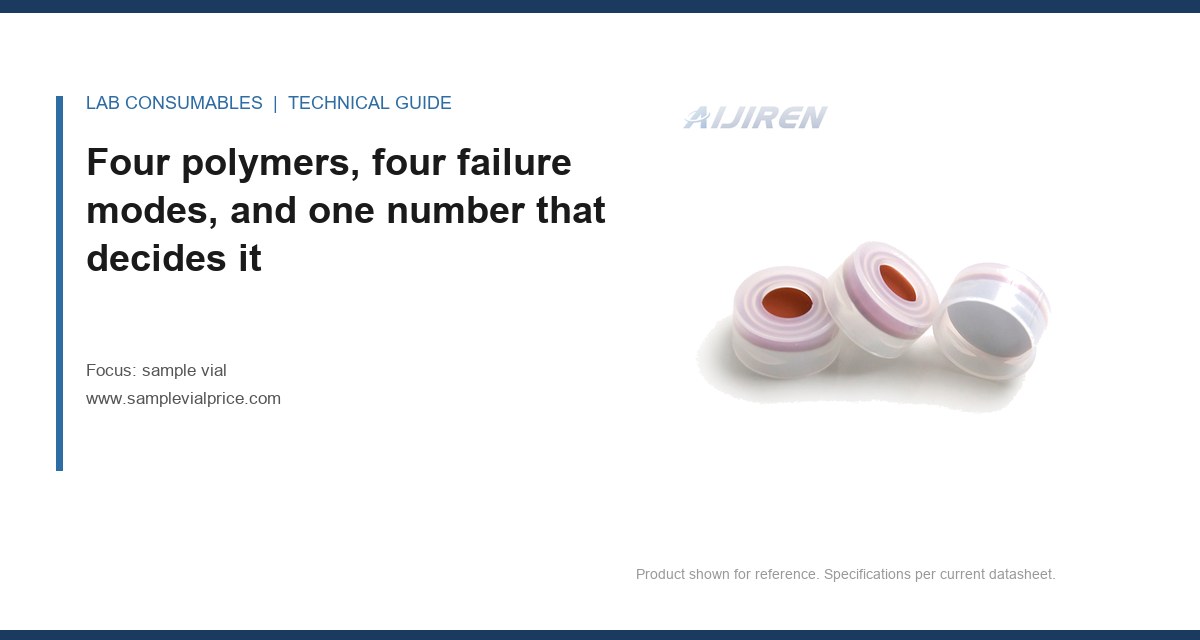
A 24-vial sequence of EPA 8260 volatiles on a 60 m DB-624 column came back with toluene at 118% recovery and the internal standard at 71%, both outside the 70-130% window, and the run had passed the same check two days earlier. The vials were the same lot. The septa were not: purchasing had switched from a PTFE-faced silicone to a straight silicone closure to save lead time, and the methanol in the preservation had started pulling the silicone into the aqueous layer through the punctures. That is the whole problem in one sentence. If the sample vial material is not matched to the solvent and the temperature the method actually runs at, the failure shows up as a recovery number, not as a visible defect. This guide is about choosing the polymer, not the vial. Dimensions, fit, and price are someone else’s page. Here we are picking the material grade for a given solvent and temperature window, and naming the failure each wrong pick produces.
Almost every sample vial closure in a regulated lab is built from one of four materials, sometimes laminated together. Each has a solvent compatibility envelope and a temperature ceiling. Outside that envelope, the polymer does not fail gracefully. It fails in a way that contaminates the chromatogram.
- PTFE (polytetrafluoroethylene): inert to nearly everything, rated continuously to about 260 °C, but it is soft and cold-flows under compression. Pure PTFE alone does not reseal well after a needle withdrawal.
- Silicone (usually a platinum-cured silicone): excellent reseal and puncture memory, usable to roughly 200 °C short-term, but swells badly in nonpolar solvents and extracts into aqueous samples.
- EPDM (ethylene propylene diene monomer): good against water, steam, and polar solvents, poor against hydrocarbons and aromatic solvents, and it is not a low-extractable material for trace organics.
- Laminate (PTFE film bonded to silicone): the PTFE face is what touches the sample; the silicone core provides the reseal. This is the default for HPLC and GC autosamplers for a reason, and it is also the material most often mis-specified because people buy the cheapest laminate and get a thin PTFE skin that scuffs through in a needle guide.
The single number that decides most of these calls is not the temperature rating on the datasheet. It is the swell percentage of the elastomer in the actual solvent at the actual temperature. A silicone septum that swells 15% in a nonpolar mobile phase will bulge into the vial headspace, reduce the effective seal, and start shedding particles into the injection port. You will not see this on day one. You will see it on day four, when the autosampler needle starts coring a swollen, softened septum and the injection volume drifts.
PTFE is the safe answer until you need it to reseal
PTFE is the material you reach for when the sample is chemically aggressive and the temperature is high. It is essentially inert to acids, bases, and organic solvents, and it holds its properties to 260 °C continuous. For a GC method running an inlet at 250 °C with a headspace transfer line, a PTFE-faced closure is the correct choice. The PTFE face does not extract, does not swell, and does not react.
The failure mode of pure PTFE is mechanical, not chemical. PTFE cold-flows. Under the cap torque of a standard 11 mm crimp or a screw cap, a solid PTFE septum will deform permanently and lose its compression set. After three or four punctures, the needle hole does not close. You get a slow leak at the headspace, and for a volatile analyte that means loss to atmosphere between sampling and injection. If you are running a method that requires a headspace-tight seal (and most volatiles methods do), a single-material PTFE septum is the wrong pick. The laminate exists precisely to fix this: the PTFE face provides the inertness, the silicone core provides the elasticity to reseal.
I have seen a lab try to solve a septum-bleed problem by going to solid PTFE across a whole GC suite. The bleed went away. The recovery of the lightest analytes dropped 8 to 12% because the septa were not resealing between the purge and the injection. The fix was a laminate with a 0.010 in (0.25 mm) PTFE film over a 0.060 in silicone core, not a switch back to bare silicone. The lesson: PTFE is a barrier, not a seal. Use it as a barrier.
Silicone reseals beautifully and extracts into everything aqueous
Silicone is the best resealing material in the cabinet. Platinum-cured silicone will take 50 to 100 punctures from a 22-gauge needle before the hole stops closing, which is why it is the core of most laminates. It is also the material that causes the most contamination events I have investigated, because it is not inert to aqueous samples and it is not inert to nonpolar solvents.
Two distinct failures come from silicone:
- In aqueous samples: silicone extracts. Plasticizers, low-molecular-weight siloxanes, and curing residues leach into the aqueous layer. In a trace organic method, this shows up as siloxane peaks in the chromatogram (m/z 73, 207, 281 in GC-MS) and as elevated baseline in LC-MS. The recovery of your analytes may be fine, but your detection limits are gone.
- In nonpolar solvents: silicone swells. Toluene, hexane, and dichloromethane will swell a silicone septum by 10 to 25% depending on cure and temperature. A swollen septum loses compression, the cap loosens, and you get evaporative loss of the volatile fraction. For a 40 mL VOC vial with a silicone-lined closure and a hexane-based extract, I have measured 5 to 9% loss of the light fraction over 24 hours at 4 °C, purely from seal relaxation.
The practical rule: silicone belongs on the outside of the sample, never as the only barrier to it. That means a laminate, or a silicone septum used only where the sample is non-aqueous and non-aggressive and the temperature is below 200 °C.
EPDM is for water and steam, not for your HPLC mobile phase
EPDM gets specified a lot because it is cheap and it handles aqueous systems well. It is genuinely good against water, steam, and polar solvents like methanol and acetonitrile at moderate temperature, up to about 150 °C continuous. If you are running an aqueous ion chromatography method or a water-quality method with a pH between 2 and 12, EPDM can be a defensible choice on cost.
Where EPDM fails is hydrocarbons and aromatics. It swells severely in toluene, xylene, and chlorinated solvents, and it is not a low-extractable material. For trace organic analysis, EPDM is the wrong polymer almost every time. It will pass a visual inspection and fail a blank injection. I have seen an EPDM closure on a semivolatile extraction vial produce a phthalate background that masked the target list at the low end of the calibration. The identification was simple: run a method blank with a new closure and compare the total ion chromatogram against a laminate blank. The EPDM blank had three extra peaks in the 149 to 167 m/z range. The fix was a PTFE/silicone laminate and a re-run of the affected batch.
EPDM also does not tolerate high temperature well in the presence of oxygen. Above 150 °C it starts to degrade, and the degradation products are not chromatographically silent. For a GC inlet at 250 °C, EPDM is out.
Laminate is the default, and the thickness of the PTFE face is the spec that matters
If you are running HPLC or GC autosampler methods with mixed solvents and you want one closure that works across the suite, the answer is a PTFE/silicone laminate. It gives you the chemical resistance of PTFE on the sample side and the reseal of silicone on the needle side. This is the closure specified in most pharmacopeial and EPA methods for a reason, and it is what you will find on the majority of sample vial products sold for autosampler use.
But “laminate” is not a single specification. The variable that decides whether a laminate survives a method is the PTFE film thickness. A 0.25 mm (10 mil) PTFE face will survive a needle passing through it repeatedly without scuffing through to the silicone. A 0.05 mm (2 mil) skin will not. After 20 to 30 punctures, a thin face develops a pinhole, the silicone core is exposed to the sample, and you are back to the silicone extraction problem with no warning. If your method uses a needle guide that drags across the septum (many autosamplers do), the thin film abrades faster.
Ask for the film thickness in the specification, not just “PTFE-faced.” If the supplier cannot give you a number in mils or millimeters, you are buying a lottery ticket. The table below is the decision matrix I use.
| Polymer / construction | Best solvent class | Avoid | Temp window (continuous) | Typical puncture life | Failure if misapplied |
|---|---|---|---|---|---|
| PTFE (solid) | Acids, bases, all organics | Anything needing reseal | to 260 °C | Poor reseal after 3-4 | Headspace leak, volatile loss |
| Silicone (bare) | Nonpolar, non-aqueous | Aqueous, trace organics | to 200 °C | 50-100 | Siloxane bleed, swelling, evaporative loss |
| EPDM | Water, polar, pH 2-12 | Hydrocarbons, aromatics | to 150 °C | 30-50 | Phthalate/background contamination, severe swell |
| PTFE/silicone laminate, 0.25 mm face | Mixed, HPLC/GC autosampler | Nothing common | to 200 °C (silicone-limited) | 50-100 | Minimal; watch face scuffing |
| PTFE/silicone laminate, 0.05 mm face | Same, short runs | High-puncture methods | to 200 °C | 20-30 | Pinhole through to silicone, extraction |
Temperature is a two-part question: the septum and the sample
People quote the septum temperature rating and stop there. The rating is the temperature at which the polymer retains its properties in air, not the temperature at which it is safe against your sample. A silicone septum rated to 200 °C will still swell in toluene at 40 °C. The temperature window that matters is the intersection of the polymer’s thermal limit and its solvent compatibility at that temperature. Swelling increases with temperature, so a septum that is marginal at ambient is over the line at 60 °C.
For headspace GC, the vial is heated to 60 to 90 °C while sealed. That is the worst case for a laminate: the silicone core is hot and under compression, and if the sample is nonpolar, it is also swelling. This is where a thin PTFE face fails first. I recommend a 0.25 mm face and a cap torque checked with a torque tester, not by feel. For an 11 mm crimp, target 1.5 to 2.0 N·m; for an 18 mm screw cap, 1.0 to 1.5 N·m. Over-torque compresses the septum past its elastic limit and accelerates the cold-flow failure. Under-torque leaves a leak path at the headspace.
pH range: where EPDM and silicone both lose
pH is the variable most often ignored, and it is the one that produces the quietest failures. PTFE is stable across the full pH range, 0 to 14. Silicone is stable roughly pH 3 to 10; outside that, hydrolysis of the siloxane backbone accelerates, and the septum softens. EPDM handles pH 2 to 12 but degrades quickly below pH 2 and above pH 12.
If your method involves a strong acid digestion or a caustic extraction, the only defensible closure is PTFE-faced, and you should confirm the face is thick enough to be the only barrier. A pH 1 sample against a bare silicone septum will produce a soft, tacky septum within a few days, and the tackiness is the tell: the surface is hydrolyzing and shedding. The symptom in the data is a rising baseline and a growing particle count at the needle.
Two field cases where the material was the variable
Case 1: the 118% toluene recovery
The opening scene. A volatiles method on a 40 mL vial with a bare silicone closure. The symptom was toluene recovery at 118% and internal standard at 71%, both outside the acceptance window, on a lot that had passed two days earlier. The measurement that identified it: a method blank run with a new laminate closure and a re-injection of the same preserved samples. The recovery returned to 96 to 103%. The fix was a switch to a 0.25 mm PTFE/silicone laminate and a re-qualification of the closure lot. The root cause was silicone swelling in the methanol preservation, which relaxed the seal and allowed the light fraction to partition differently between the aqueous and headspace phases. The material was the variable, not the instrument.
Case 2: the phthalate background on a semivolatile batch
A semivolatile extraction method on 40 mL vials with EPDM-lined closures. The symptom was a phthalate background at the low calibration point that failed the method blank criterion on three consecutive batches. The measurement that identified it: a side-by-side blank injection of an EPDM closure and a laminate closure on the same instrument. The EPDM blank had three extra peaks at m/z 149, 167, and 279. The fix was a laminate closure and a re-extraction of the affected samples. The root cause was EPDM plasticizer extraction into the solvent. The lesson is that EPDM is a cost choice, and on trace organics the cost is a failed blank.
Both cases have the same shape: the polymer was chosen on price or availability, the failure appeared as a data quality number, and the identification required a controlled blank comparison. If you are building a closure qualification into your method, that blank comparison is the test. Run it once per lot. It takes an hour and it catches the material mismatch before it reaches a reportable result.
A closure selection checklist you can run before the next lot
Before you commit a closure to a method, answer these in writing. If any answer is “I don’t know,” the material is not qualified.
- Solvent class: is the sample aqueous, polar organic, nonpolar, or mixed? A nonpolar or aromatic solvent rules out bare silicone and EPDM.
- pH: below 3 or above 10? Then only a PTFE face is defensible.
- Maximum temperature the sealed vial sees: above 150 °C rules out EPDM; above 200 °C rules out silicone-based cores, so you need a PTFE-faced closure with a high-temperature core or a different sealing approach.
- Puncture count per vial: more than 30? Then specify a 0.25 mm PTFE face, not a thin skin.
- Headspace-tight requirement: if yes, do not use solid PTFE. Use a laminate.
- Trace organic detection limit: if you are below 1 ppb, run a closure blank before you buy a case.
- Cap torque: specify a target (1.5 to 2.0 N·m for 11 mm crimp) and check it with a gauge, not by hand.
For the instrument-side context on how the closure interacts with the inlet and column, the Agilent GC columns and accessories documentation and the Thermo Fisher chromatography and sample handling resources both publish septum bleed and compatibility data worth reading against your own method. The Restek technical library has solvent compatibility charts that are more granular than most supplier datasheets. For regulatory context on what the container has to survive, the EPA SW-846 methods define the preservation and holding requirements that drive the material choice.
What to specify on the purchase order
Write the polymer and the construction, not the catalog number. A purchase order that says “PTFE/silicone laminate, 0.25 mm PTFE face, silicone core, 11 mm crimp” is a specification. A purchase order that says “septa, 11 mm” is a hope. Add the temperature window and the solvent class the method uses, and require a lot-specific compatibility statement. If you buy through a distributor, the vials with caps catalog is a reasonable place to confirm that the closure and the vial are qualified as a pair, because a laminate that is qualified on one vial body is not automatically qualified on another. The manufacturing side, if you are sourcing direct, is worth a conversation about what the Aijiren line can hold on film thickness and lot traceability. And if you are comparing across a full autosampler suite, the chromatography products index will show you how the closure grades map to instrument families.
The decision rule
Match the polymer to the solvent first, then to the temperature, then to the puncture count. PTFE for aggressive chemistry and high temperature, but never as the only seal. Silicone only where the sample is non-aqueous and the reseal matters more than the extractables. EPDM only for aqueous and polar systems below 150 °C, and never on trace organics. Laminate as the default for autosampler methods, with the PTFE face specified at 0.25 mm and the cap torque checked at 1.5 to 2.0 N·m for an 11 mm crimp. If you cannot state the solvent class, the pH, and the maximum sealed temperature for your method, you are not ready to choose a material. Pick the closure that survives the worst of those three, and run a closure blank before the first lot is released.
References & further reading
Related resources from our lab consumables network:
- Sample Vial at samplevialprice.com
- Chromatography Products at chromatographyselling.com
- Aijiren at aijirentech.com
- Vials With Caps at vialswithcaps.com
External references and standards: